
We have heard this story before.
A new technology arrives. The promise is enormous. The presentation is persuasive. The organization buys it—and waits for transformation to follow.
Sometimes it does. Often, the difficult work begins exactly where the presentation ends.
Artificial intelligence makes the promise especially compelling because the capabilities are genuinely impressive. I am not arguing that the technology is fake. I am arguing that capability is not the same as organizational readiness.
That is the question at the center of my keynote, Ready or Not: why would we expect AI to transform an organization that is not ready to change?
The promise is real. So is the distance to value.
AI can help people draft, analyze, summarize, classify, and discover. In the right setting, with the right safeguards, it can make work materially better.
But an impressive demonstration is not a redesigned operating model. A tool that saves someone ten minutes does not automatically save the organization ten minutes’ worth of cost. A successful pilot does not establish that a system is safe to scale.
Those distinctions are not objections to innovation. They are how we keep innovation honest.
McKinsey’s November 2025 State of AI survey makes that distinction visible. Sixty-four percent of respondents said AI was enabling innovation at their organizations. Thirty-nine percent reported enterprise-level EBIT impact from AI.
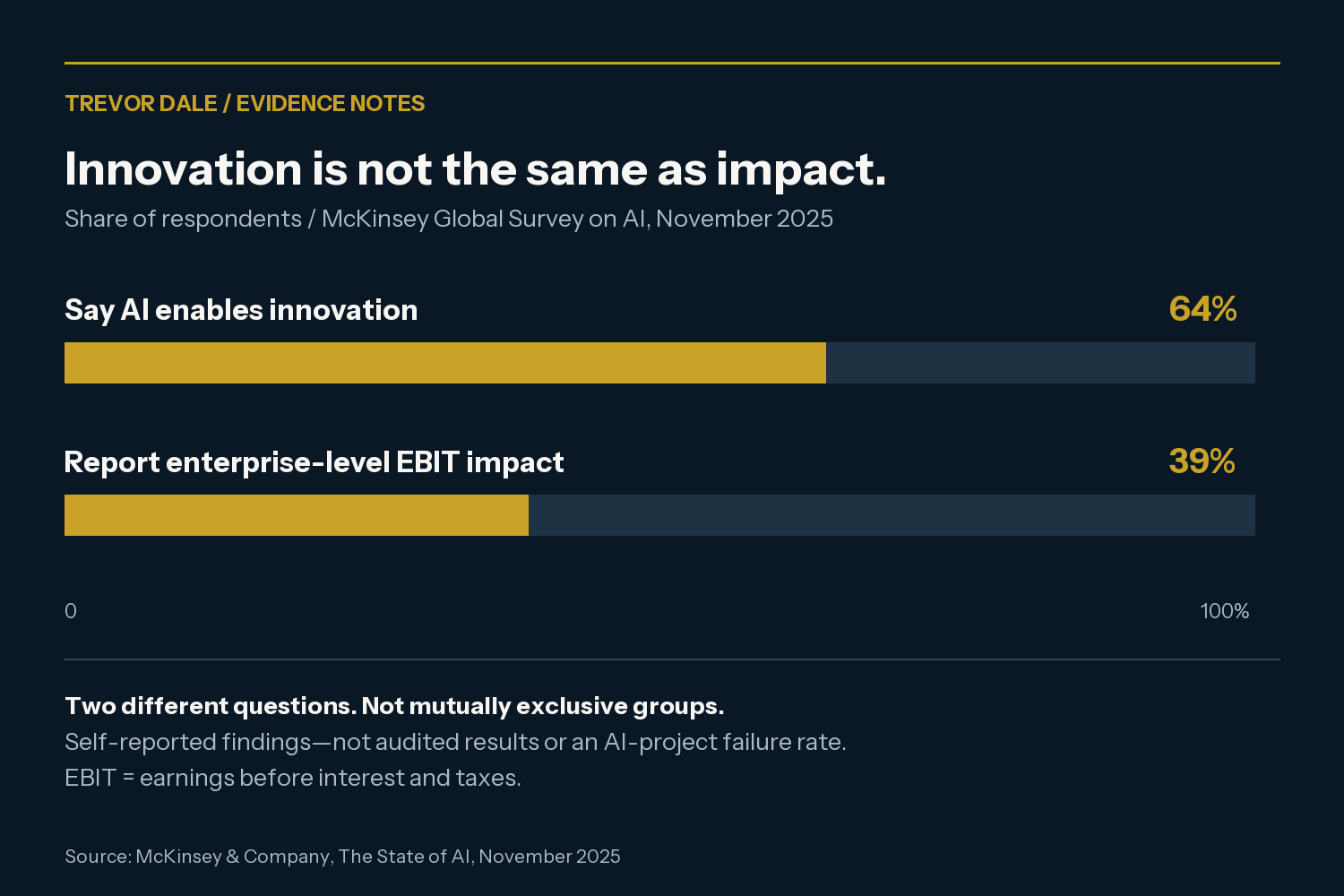
Do not read that chart as “61 percent of AI projects fail.” It does not say that. Nor does innovation have to show up immediately in profit. Respondents may be describing early-stage work, benefits outside EBIT, or impacts they cannot yet measure.
What it does tell us is that excitement, innovation, and enterprise financial impact are not interchangeable measures. Leaders need to know which one they are discussing.
Maybe the problem is not the technology.
Maybe the process was unclear before we automated it.
Maybe departments use different definitions of the same customer, patient, or result. Maybe nobody owns the handoff. Maybe the people expected to change have neither time to learn nor permission to question the plan.
Maybe the initiative has a sponsor, but no one accountable for the result after launch.
Technology does not reliably solve those problems by being installed. It can make them faster and less visible.
If we automate an unreliable process, we should not be surprised when we get unreliable work at greater speed.
The bridge between capability and value
Capability — what the tool can do
Readiness — strategy, people, process, data, governance
Adoption — what changes in real work
Measured value — the outcome, cost, quality, and risk we can demonstrate
This is a practical way to organize the conversation, not a formula that predicts success. Each link needs evidence.
Strategy: What problem matters enough to solve? What outcome would count as better? A use case without a purpose is an activity looking for a justification.
People: Who must work differently? What do they need to learn? What concerns are reasonable? Resistance can be useful information about a design that does not fit the work.
Process and data: Is the workflow understood? Are the inputs reliable, permitted, and suitable for the task? You cannot govern a decision you cannot trace.
Governance: Who approves use, monitors performance, catches errors, and decides when to stop? Accountability does not disappear because a model generated the answer.
Try one use case—and measure the whole job
Imagine a team using AI to draft routine customer correspondence. That is an illustrative example, not a client result.
Before introducing the tool, establish the baseline: time to produce an approved response, correction rate, review effort, and customer complaints. Decide what information the tool may receive and which decisions remain human.
Then test on a bounded set of appropriate cases. Include the time people spend checking and correcting outputs. A faster first draft is useful only if the whole job becomes better.
Name a person responsible for the outcome. Agree on a review date and stopping conditions. Expand when evidence justifies it—not because the pilot made an attractive slide.
The next-day challenge
At the end of Ready or Not, I want leaders to leave with questions they can use immediately:
- What business outcome are we trying to improve, and what is our baseline?
- What must change in people’s actual work for that outcome to happen?
- What will we stop doing to create capacity for learning and adoption?
- Who owns the result, the risk, and the decision to continue or stop?
- What evidence would make us change our minds?
Start there. Not with a shopping list.
The Readiness Compass offers a private, structured way to reflect on the organizational foundations. It is a self-assessment, not a certification or a guarantee of financial returns.
Ready is a practice, not a purchase.
Being ready does not mean having perfect data, universal agreement, or no uncertainty. It means having enough clarity, capacity, safeguards, and feedback to learn responsibly.
That work is human. It is leadership. And it connects directly to A Million Needles: a workforce buried in competing demands does not become adaptive simply because another tool arrives.
Before you ask whether your organization is ready for AI, ask whether your organization is ready to change.
Explore Ready or Not, or book Trevor to bring the readiness conversation to your next event.
Sources and context
- McKinsey & Company: The State of AI: Global Survey 2025, November 2025 wave. Sixty-four percent reported AI enabling innovation; 39 percent reported enterprise-level EBIT impact. Global, cross-industry respondent reports—not audited company results. Different questions measure different outcomes; these figures do not establish an AI-project failure rate.
An essay by TREVOR DALE.More writing →