
A notification. A headline. A bill. A restructuring announcement. A technology we are told we must understand before lunch. Another argument. Another crisis. Another reason to worry about our children, our careers, or the future.
None of those things has to be catastrophic on its own. That is the point.
One needle rarely breaks us. The problem is the accumulation.
I call my new keynote A Million Needles because that is what modern life can feel like: not one enormous enemy we can point to, but a constant succession of small demands that never quite allow us to stop reacting.
This is not a talk about technology destroying humanity. It is a talk about what comes next—and what we can choose.
The sword was never a golden age
For much of human history, many threats were immediate and recognizable. Hunger. Disease. Violence. Survival. You could often see what you were up against.
That does not mean people lived simple, peaceful lives. They experienced extraordinary suffering, uncertainty, and pressures they could not explain. Visible threats have not disappeared today, either.
The sword and the needles are a metaphor, not a history textbook. The contrast is about the experience of pressure: a recognizable danger versus demands arriving simultaneously from every direction.
We have built remarkable tools for knowing what is happening everywhere. We have not necessarily built equally good habits for deciding how much of everywhere belongs in our lives.
More connected is not the same as more connected to each other
We can communicate across the planet in seconds. Learn from people we will never meet. Use AI to translate, organize, explore, and create. Those are real gains. I want more people to benefit from them, not fewer.
But connectivity does not guarantee connection. Information does not guarantee understanding. Technological progress does not automatically create human progress.
Consider one measure of how our relationship with connectivity has changed. Pew Research Center found that 46 percent of U.S. teens ages 13–17 said they used the internet almost constantly in 2024, compared with 24 percent in 2014–15.
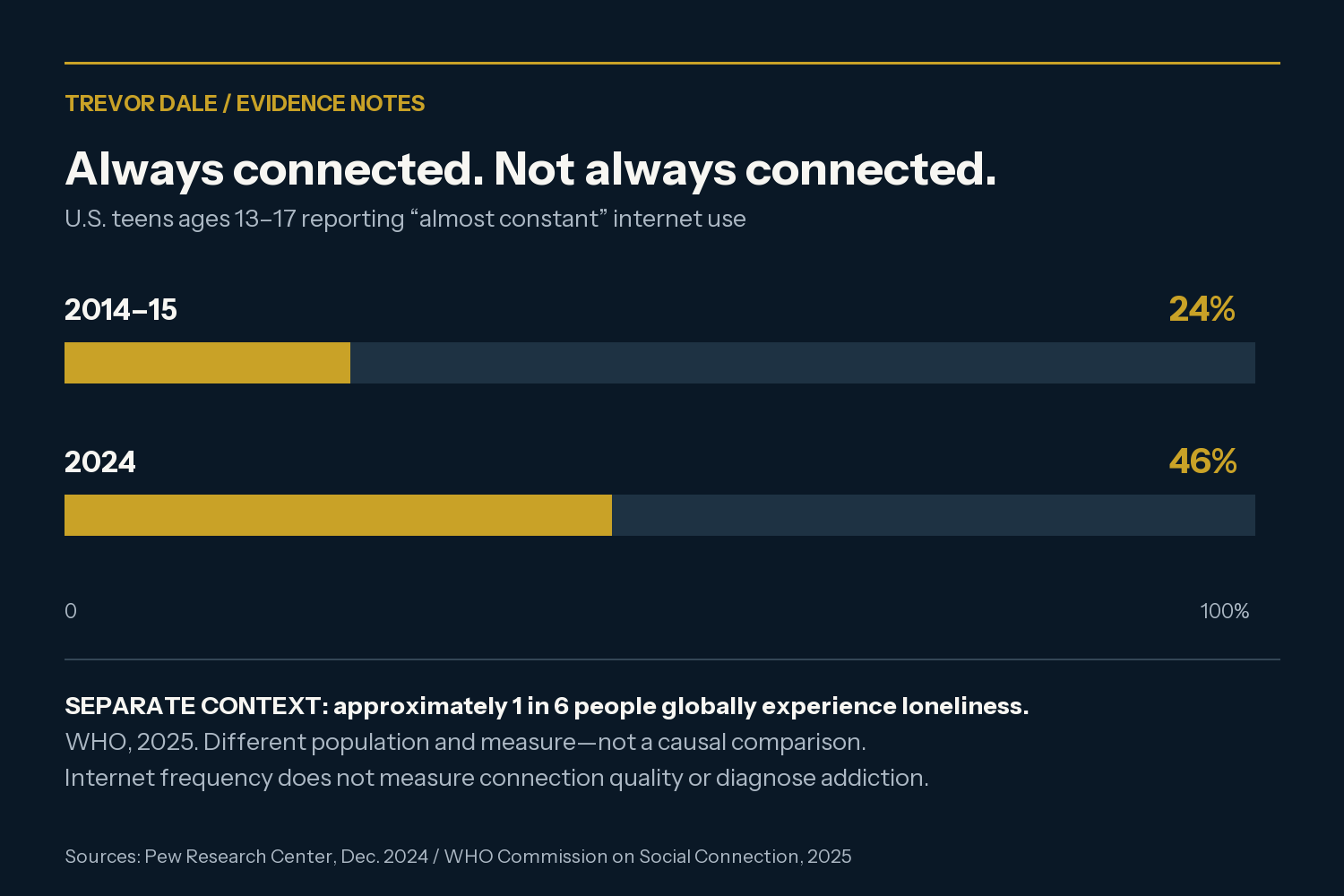
That is a change in self-reported frequency, not a diagnosis of addiction or a measure of the quality of those hours. Some online time connects people to support, friendship, opportunity, and belonging.
Separately, the World Health Organization’s Commission on Social Connection reported in 2025 that approximately one in six people globally experience loneliness. Loneliness is a subjective experience; social isolation concerns the extent of social contact. They are related, but not interchangeable.
Those findings come from different populations and different research methods. Putting them beside each other does not prove that being online causes loneliness. It does underline a question we should stop avoiding: what kind of connection are we actually building?
What if we are fighting the wrong battle?
The usual prescription is to keep up. Read more. Learn faster. Answer sooner. Be informed about everything.
But keeping up with every demand is not a serious plan for a finite human being.
We cannot respond to every crisis, absorb every piece of information, or control every technological, political, and economic change. And perhaps we were never supposed to.
The turning point is learning to distinguish what deserves our attention from what merely knows how to capture it.
A demand arrives.
Does it matter to something I am responsible for?
Can I influence it—or work with someone who can?
Act intentionally. Seek help. Or let it pass.
This is a decision aid, not an excuse to ignore suffering or civic responsibility. Sometimes paying attention is the first step toward helping. The question is whether attention leads anywhere—or simply leaves us exhausted.
Three choices that give us something back
Reclaim attention. Stop giving every crisis equal authority over your day. Choose a bounded time to get informed. Protect one uninterrupted period for something that matters. If you lead a team, ask which interruptions your own expectations create.
Rebuild connection. Replace an assumption with a question. Have a conversation that is not a competition. Participate somewhere you can be useful. A message can begin a relationship; the relationship still needs attention, trust, and reciprocity.
Restore agency. Find one thing you can make right. A broken handoff at work. A neighbor who needs help. A local meeting you can attend. A family conversation you have postponed. Make the next step specific enough to do.
None of these choices abolishes hardship. They are practical ways of recovering a little room to respond rather than merely react. They are not substitutes for mental-health care, material support, or institutional change when those are needed.
The leader’s responsibility
An organization can become a million needles of its own. Every priority is urgent. Every message expects an answer. Every new tool arrives without removing any old work.
Then we ask why people are struggling to adapt.
Before announcing the next transformation, name what will stop. Make room to learn. Give people a way to challenge unrealistic demands without being labeled resistant.
That is where this talk meets Ready or Not. The future is coming. But readiness is not simply whether we can operate the technology. It is whether we can live and work well with what it asks of us.
Choose something
We may never stop the million needles. We can decide which ones get our attention. We can choose understanding over hostility, connection over isolation, and action over helplessness.
You cannot solve everything. But you can choose something.
The future does not need us to become less human to keep up. It needs us to become more human than ever.
Explore A Million Needles, the keynote, or book Trevor to bring this conversation to your team.
Sources and context
- Pew Research Center: Teens, Social Media and Technology 2024, December 12, 2024. Survey of 1,391 U.S. teens ages 13–17, September 18–October 10, 2024; comparison with Pew’s 2014–15 teen survey. Self-reported internet frequency, not a causal study.
- WHO: Social connection questions and answers, and the 2025 Commission on Social Connection report. Global loneliness estimates synthesize research across countries; they do not measure the same population as Pew’s teen survey.
An essay by TREVOR DALE.More writing →