For decades, healthcare has been remarkably good at identifying problems.
We need more preventive care. Better access. Earlier detection. Fewer avoidable emergency-department visits. Better management of chronic conditions. More ways to bring care to people instead of always requiring people to come to us.
None of that is controversial. The trouble begins when we talk about those goals as if each were a separate problem with a separate solution.
They are not.
In modern healthcare, there may be very few simple problems left to solve. We have handled many of the obvious ones. What remains are systems problems: pull one thread, and three more move with it. Preventive care is a good example because it sounds so straightforward. Identify risk earlier. Intervene earlier. Prevent illness when possible, delay its progression when we cannot, and limit the damage of chronic disease.
That is essentially how the Centers for Medicare & Medicaid Services describes preventive care. It includes screenings, vaccines, checkups, counseling, and the early detection and management of potential problems.
It is a compelling proposition. Find hypertension before it contributes to a stroke. Manage diabetes before it produces kidney, cardiovascular, neurologic, or vascular complications. Build a system that helps people remain healthy instead of waiting to treat them after they become seriously ill.
So let’s do it.
And immediately, things get complicated.
Prevention does not happen once a year
A patient’s health does not exist only during the twenty minutes they spend in an examination room. Blood pressure changes. Weight changes. Glucose changes. Medications change. Behaviors change. Symptoms emerge. Risk accumulates between appointments.
If we genuinely want care to become more preventive, we need a better picture of what is happening in people’s lives between traditional encounters. That is one reason remote patient monitoring is so promising.
CMS describes remote patient monitoring as a way for patients to collect health information—such as blood pressure, weight, and glucose—using a connected medical device that transmits the data to a healthcare provider. The provider then uses those data to treat or manage the patient’s condition. CMS also makes clear that the service is more than a device: it includes education and setup, an appropriate connected device, transmission of readings, and treatment management by the care team.
Now imagine what that can make possible. A patient with hypertension may not have to wait months for someone to discover a worsening trend. Glucose readings can inform diabetes management between office visits. Weight and other clinically appropriate measures can add context that no single appointment can provide.
We stop seeing snapshots and start seeing the movie.
But a movie creates far more information than a snapshot, and someone has to watch it.
Data is not care until someone acts
Giving a patient a connected blood-pressure cuff does not, by itself, improve that patient’s health. Doing something useful with the information might.
Ten patients transmitting readings may be manageable. What happens when ten thousand do? Who decides what is abnormal? Who receives the alert? How quickly must someone respond? What happens overnight? What if the patient cannot be reached? What if the device is wrong? What if hundreds of low-value alerts teach clinicians to ignore the one that matters?
Then there is the question of where the information goes. If it lives in a separate application, the clinician may have one more screen to check and one more workflow to remember. If it enters the electronic health record without structure or context, more data may create more noise rather than better decisions.
This is where the human layer matters. Technology can identify a change, but a care team still needs the authority, time, training, and clinical judgment to respond. Patients need to understand why they are being monitored and trust how their information will be used. Organizations need clear rules for privacy, cybersecurity, escalation, accountability, and measurement. Otherwise, a well-intended innovation becomes another disconnected task placed on an already strained workforce.
We began with a simple idea: monitor patients earlier. We have now created questions about clinical workflow, interoperability, data architecture, cybersecurity, staffing, liability, governance, trust, and artificial intelligence.
And we are not finished.
Virtual care still needs a physical healthcare system
Telehealth gives us another extraordinary tool. Many counseling, follow-up, behavioral-health, medication-management, and stable chronic-care encounters can be performed virtually when the value of the visit comes primarily from conversation, evaluation, education, and decision-making.
But virtual care is not a universal replacement for the examination room. Patients still need vaccinations, blood draws, imaging, procedures, and hands-on examinations. An abnormal remote reading may eventually require a person to evaluate the patient in a physical place.
The future is not “virtual replaces in-person.” It is a hybrid system capable of deciding which care should happen where, when, and by whom—and then making the handoff feel like one system rather than two.
That creates the next dependency: virtual healthcare works only if the patient can connect to it.
A healthcare innovation can become a broadband problem
The digital divide is real, particularly in rural America, but precision matters. The FCC’s 2026 broadband report used June 2025 data and found that 79 percent of rural Americans were in areas with both qualifying 5G service and fixed broadband at 100/20 Mbps when every fixed technology—including satellite—was counted. When the fixed side was limited to wireline technology, the rural figure fell to 61.1 percent. The comparable urban figures were 99.3 and 98 percent.
Those are modeled availability estimates, not proof that every household subscribes to an affordable, reliable service or receives the advertised performance. Availability is not the same as practical access. A network may reach a community while a patient still struggles with price, reliability, equipment, digital literacy, accessibility, or a confusing collection of applications, portals, passwords, and devices.
That distinction matters. We can build the greatest remote-care platform in history, but if the intended patient cannot connect to it—or does not trust it, understand it, or have a safe place to use it—we have created an innovation that does not reach the person it was designed to help.
Our healthcare problem has now become a telecommunications, affordability, design, and education problem.
Technology without workflow is just more technology
Suppose we solve connectivity. The patient has the device. The device works. The patient knows how to use it. The information arrives.
Wonderful. Where does it go?
Does it integrate into the electronic health record as useful, structured information? Can systems exchange it? Can clinicians distinguish signal from noise? Can an algorithm identify a meaningful trend without producing thousands of unnecessary alerts? Who owns the workflow: a nurse, a physician, a centralized monitoring team, or an outside company? When an abnormality appears, who owns the next action?
Digital transformation cannot simply mean purchasing technology. Every technology creates a human workflow around it. Every workflow requires people. People require training and capacity. Capacity costs money.
Preventive care requires earlier detection and sustained engagement.
Earlier detection benefits from information gathered between office visits.
Longitudinal care may use telehealth and remote patient monitoring.
Connected care requires reliable infrastructure, usable devices, and patient trust.
More data requires integration, governance, security, and intelligent alert management.
An alert requires a responsible person with the time and authority to act.
That person, that time, and the follow-up care all have to be financed.
You cannot demand a new model of care while financing the old one
We can tell providers all day long that we want them to prevent disease. Eventually, we have to ask whether the financial structure around them makes that work possible.
CMS describes value-based care as compensating providers based on performance, quality, and patient experience rather than only the volume of services. That direction matters because prevention requires infrastructure: care coordination, patient education, clinical review, follow-up, redesigned workflows, data capability, and the people who perform all of that work.
Some CMS programs recognize the investment problem directly. The Medicare Shared Savings Program offers qualifying accountable care organizations advance investment payments that can support staffing, healthcare infrastructure, and services for underserved beneficiaries. In July 2026, the new voluntary ACCESS Model began testing outcome-aligned payment for technology-supported care for chronic conditions. It exists because, as CMS itself says, payment barriers can limit access to those services.
These programs do not prove that one payment model will solve prevention. They do prove that payment design is part of the clinical design. A system cannot consistently ask people to coordinate, monitor, educate, and intervene upstream while treating those activities as incidental expenses.
Patients are part of the system too. Benefit design can make screenings, preventive appointments, connected care, and chronic-condition management easier—or harder—to use. CMS has previously tested direct beneficiary incentives through a ten-state Medicaid initiative addressing tobacco cessation, weight, cholesterol, blood pressure, and diabetes prevention or management.
That precedent should not be read as “pay people to be healthy.” Incentives can produce unintended consequences, and no patient should be penalized for medical or social circumstances beyond their control. The better question is: how do we align the interests of patients, clinicians, health systems, employers, payers, and government around keeping people healthier while protecting access, quality, and equity?
If prevention creates value across the system, the people doing the work of prevention should be able to participate in that value.
Watch what happened to our simple problem
We began with one idea: improve preventive care. Follow it through the real system and this is where it takes us:
Clinical care connects to technology.
Technology connects to infrastructure.
Infrastructure shapes access.
Access depends on trust, affordability, literacy, and equitable design.
Access creates workflow and workforce demands.
Workflow depends on payment and incentives.
Payment is shaped by employers, insurers, health systems, states, CMS, and federal law.
Policy returns us to institutions—and ultimately to people.
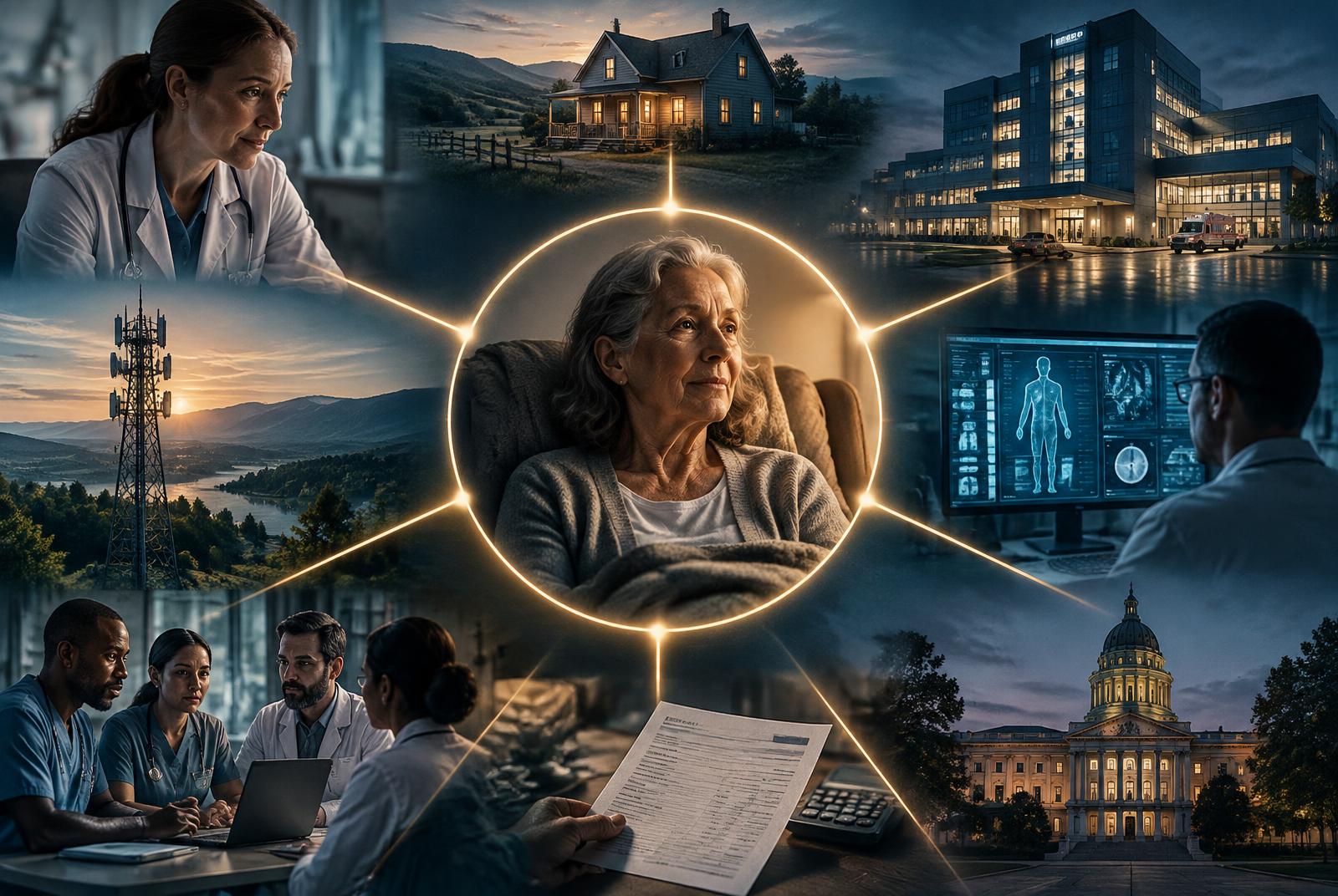
The clinical problem became a technology problem. The technology problem became an infrastructure problem. The infrastructure problem became an access problem. The access problem became a workforce problem. The workforce problem became a financial problem. The financial problem became a policy problem.
That is not mission drift. That is the system revealing itself.
Healthcare does not operate outside democracy
Eventually, many of healthcare’s largest structural problems leave the walls of the hospital. Broadband policy matters. Insurance regulation matters. Medicare and Medicaid policy matter. Licensure and scope-of-practice laws matter. Infrastructure spending, state budgets, local public-health capacity, and federal legislation matter.
Those decisions are not made by an electronic health record. They are not made by an AI model, and they are not solved by another dashboard. They are made through public and private institutions—and public institutions respond, imperfectly but necessarily, to civic participation.
Healthcare leaders, clinicians, technologists, patients, and citizens therefore have another responsibility: engage. Understand which level of government controls the issue in front of you. Know who represents you. Explain what healthcare actually looks like where you live and work. Show where broadband fails, where reimbursement fights prevention, where regulation creates an avoidable barrier, and where patients disappear into gaps that never appear on an executive dashboard.
And vote throughout the ballot, not only at the top of it.
No single level of government is universally more important. Authority changes by issue. But state and local decisions can have immediate consequences for care delivery, public health, infrastructure, and community services. Those decisions deserve the same serious attention we give national debates.
Democracy is not something healthcare operates outside of. Healthcare is deeply shaped by it.
Complexity is not an excuse
There are no more simple problems in healthcare. That does not mean every improvement requires us to solve the entire American healthcare system before Monday morning. It means we have to define the boundary of the problem honestly, identify the dependencies that can defeat the work, and decide who owns each handoff.
AI will not fix healthcare by itself. Neither will telehealth, remote patient monitoring, interoperability, broadband, value-based care, payment reform, or legislation. Each may be necessary in the right setting. None is sufficient on its own.
The next era of healthcare will depend less on finding one extraordinary answer and more on making the answers work together. Better care for patients at a better cost for people requires clinical care to connect to technology; technology to infrastructure; infrastructure to access; access to workflow; workflow to reimbursement; reimbursement to incentives; incentives to policy; and policy back to people.
That is not a reason for pessimism. It is a reason to change how we solve problems.
Stop asking whether an isolated idea works in isolation. Ask what it depends on, what depends on it, who must act next, how success will be measured, and what could fail when the idea meets the real world.
The challenge ahead is not finding the next isolated answer.
It is finally learning to solve the whole problem.
Sources
- Centers for Medicare & Medicaid Services, Preventive Care — definition, examples, and the role of early detection and management.
- Centers for Medicare & Medicaid Services, Remote Patient Monitoring — connected devices, education and setup, transmission, and treatment management.
- Federal Communications Commission, 2026 Section 706 Report, paragraph 42 and Figure 9 — June 2025 rural and urban fixed-plus-mobile availability estimates.
- Pew Research Center, Internet/Broadband Fact Sheet — household adoption differences by geography, income, age, education, and race.
- Centers for Medicare & Medicaid Services, Value-Based Care: Information for Providers — performance, quality, patient experience, and risk-based arrangements.
- Centers for Medicare & Medicaid Services, Advance Investment Payments Guidance, April 2026 — permitted investments by qualifying accountable care organizations.
- Centers for Medicare & Medicaid Services, ACCESS Model — outcome-aligned payment for technology-supported chronic care, begun July 2026.
- Centers for Medicare & Medicaid Services, Medicaid Incentives for the Prevention of Chronic Diseases Model — a completed ten-state test of preventive-health incentives.
An essay by TREVOR DALE.More writing →