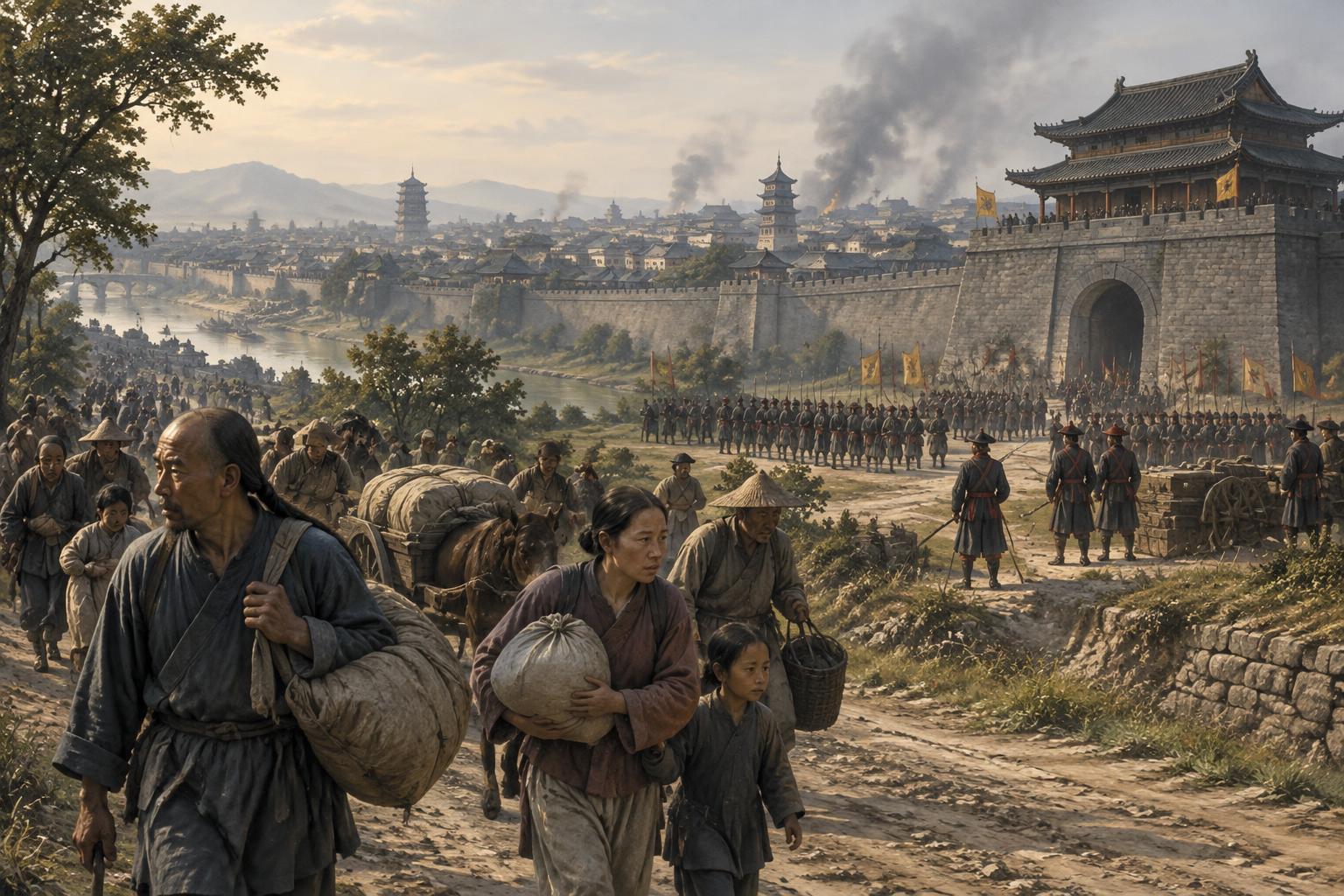
While America Was Divided, China Was Dying by the Millions
What if I told you that while America was fighting its Civil War, another nation was experiencing a conflict with an estimated death toll of 20 million or more?
Not World War I. Not World War II.
A civil war.
And there’s a good chance you’ve never heard of it.
Between 1850 and 1864, China experienced one of the deadliest internal conflicts in human history: the Taiping Rebellion.
It overlapped with the American Civil War, yet its commonly cited death estimates are vastly larger. The figures measure different kinds of losses, a distinction we need to keep in view.
The American Civil War fundamentally transformed the United States. The Taiping Rebellion devastated enormous portions of China, destabilized an empire, and helped shape the country’s future.
Both deserve our attention.
But before comparing them, we need to understand how a failed Chinese scholar who believed himself to be the younger brother of Jesus Christ nearly brought down one of the world’s most powerful empires.
An Unlikely Revolutionary
Our story begins with Hong Xiuquan, born in southern China in 1814.
Hong was an ambitious young man who repeatedly attempted to pass China’s notoriously difficult imperial civil service examinations. These examinations offered one of the few pathways to government employment and social advancement.
He failed. Repeatedly.
Following one of these failures, Hong experienced a psychological and spiritual crisis. He later interpreted a series of visions through Christian religious literature he had encountered.
He became convinced that he was the younger brother of Jesus Christ, divinely appointed to cleanse China of evil and establish a new heavenly kingdom.
To modern readers, the claim sounds extraordinary.
But Hong’s message found an audience among people already suffering under economic hardship, social inequality, ethnic tensions, and resentment toward the ruling Qing dynasty.
His movement grew from a religious community into a revolutionary army.
By 1851, Hong had proclaimed the Taiping Heavenly Kingdom.
By 1853, his forces had captured Nanjing, one of China’s great cities, and established it as their capital.
A religious movement had become a rival government.
And China was descending into catastrophe.
Two Civil Wars. Two Continents. One Era.
In 1861, the United States fractured over slavery, secession, and the future of the American republic.
Eleven Southern states attempted to leave the Union, triggering four years of brutal warfare.
Across the Pacific, China had already been fighting its own devastating internal war for more than a decade.
The two conflicts were fundamentally different.
The American Civil War centered on slavery and the constitutional and political future of the United States.
The Taiping Rebellion combined religious revolution, opposition to Qing rule, social reform, ethnic conflict, and the struggle for political power.
Yet both demonstrate what happens when divisions within a society become so severe that political institutions can no longer contain them.
And the scale of China’s catastrophe was staggering.
The Human Cost
These are historical estimates, not precise death certificates. Some modern research suggests American Civil War military deaths may have been closer to 750,000, while the Taiping estimates remain especially uncertain.
Comparing a broad estimate of 20 million deaths in China with an estimate of 750,000 military deaths in America, the Taiping Rebellion’s estimated toll was approximately 27 times greater.
At the upper end of the Taiping estimate, the ratio approaches 40 times when the American denominator remains 750,000. These are not equivalent counts: Taiping estimates include civilian deaths, while the familiar American figures estimate military deaths. This is an illustration of scale, not a precise comparison of total human losses.
But numbers alone don’t convey the human reality.
The death toll in China included not only soldiers killed in battle but also civilians lost to famine, epidemics, massacres, displacement, and the destruction of agricultural communities.
Entire regions were devastated.
Families disappeared.
Communities that had existed for generations were destroyed.
And much of the world beyond China barely understood the magnitude of what was happening.
01 / The human cost
Two wars. Unequal measures of loss.
Solid bars reach the lower estimate; lighter extensions show the cited range. Both use the same scale.
≈27–40×20–30 million divided by 750,000. This illustrative ratio holds the American estimate fixed at its upper cited value; it does not compare equivalent civilian-inclusive death counts.
Why Was the Taiping Rebellion So Deadly?
The answer is more complicated than the number of battles fought.
China’s population around the middle of the nineteenth century was roughly 400 million people, several times larger than that of the United States.
The Taiping conflict spread across heavily populated regions and disrupted the systems that sustained millions of lives.
Three factors made the devastation particularly severe.
First, agricultural destruction. Armies seized food, destroyed farmland, interrupted planting cycles, and disrupted transportation. In an agrarian society, destroying the food supply could kill far more people than the battlefield itself.
Second, disease and displacement. Millions of people fled their homes. Refugee movements, overcrowding, inadequate sanitation, and malnutrition created conditions in which infectious diseases could spread rapidly.
Third, prolonged warfare and mass violence. The rebellion lasted approximately fourteen years. Both Taiping and Qing-aligned forces committed atrocities, and successive military campaigns devastated civilian populations.
The result was a humanitarian catastrophe that extended far beyond conventional military casualties.
The rebellion also overlapped with other major upheavals in China, complicating historians’ efforts to attribute every death to a single conflict.
This is why we should treat the 20–30 million figure as an approximate historical range, not a precise count.
A Revolution That Promised a Different Society
What makes the Taiping Rebellion especially interesting is that it was not simply a military uprising.
Hong’s movement proposed a radical transformation of Chinese society.
Its ideology challenged traditional religious practices and the authority of the Qing dynasty. It advocated redistribution of land, communal economic arrangements, and restrictions on practices such as foot binding.
Women were offered certain roles and opportunities unusual for the period, although the movement also enforced strict gender segregation and severe social controls.
There was a profound contradiction between its promises of a more equitable society and the authoritarian, often violent government it created.
That contradiction matters.
History repeatedly demonstrates that revolutionary movements can promise liberation while creating new systems of coercion.
The Taiping leadership was no exception.
How Did It End?
By the early 1860s, the rebellion was losing momentum.
Internal leadership struggles, military setbacks, and the increasing effectiveness of Qing-aligned armies weakened the movement.
Regional Chinese forces, including armies organized by officials such as Zeng Guofan, played decisive roles in suppressing the rebellion.
Western powers, concerned about their commercial and political interests, also provided varying degrees of assistance to Qing-aligned forces.
In 1864, Nanjing fell to imperial forces.
Hong Xiuquan had died shortly before the city’s capture.
The Taiping Heavenly Kingdom collapsed, although resistance continued in some areas.
The Qing dynasty survived, but its authority had been severely weakened.
The rebellion helped accelerate the rise of powerful regional military leaders and contributed to the long-term destabilization of imperial China.
The Qing dynasty would eventually fall in 1912.
It would be inaccurate to say the Taiping Rebellion alone caused that collapse. But it was unquestionably one of the great crises that undermined the empire.
Why Do Americans Know So Little About It?
Here is where the story becomes particularly revealing.
Ask an American student about the Civil War, and they may recognize Abraham Lincoln, Gettysburg, Robert E. Lee, Ulysses S. Grant, and the Emancipation Proclamation.
Ask that same student about Hong Xiuquan or the Taiping Heavenly Kingdom, and you may receive a blank stare.
Why?
Part of the answer is entirely understandable.
American schools emphasize American history. The Civil War was foundational to the nation’s development, the destruction of slavery, and the continuing struggle over citizenship and equality.
Its prominence is justified.
But there is a difference between understanding our own history and understanding world history.
The American Civil War was not the only civilization-shaping conflict of the 1860s.
Our historical education can create an unintended distortion: events become important in our minds partly because of how frequently we encounter them, rather than because of their global magnitude.
That does not make the American Civil War less significant.
It makes our understanding of the nineteenth century incomplete.
02 / Two wars, one era
Across the Pacific, at the same time.
Both civil wars underway
The American Civil War begins. Both conflicts are now underway.
The Difference Between Historical Importance and Historical Familiarity
Consider what these two conflicts reveal.
The American Civil War lasted four years and resulted in the abolition of slavery in the United States through military victory and constitutional change.
The Taiping Rebellion lasted roughly fourteen years, caused catastrophic population losses, and weakened a dynasty that had ruled China since 1644.
One transformed a republic.
The other profoundly destabilized an empire.
Neither can be reduced to a death toll.
Historical significance is measured not only by how many people died, but also by what changed, what survived, and what consequences continued across generations.
Still, the sheer scale of the Taiping Rebellion forces us to reconsider how narrowly we sometimes view the past.
03 / Geography of two civil wars
One ocean. Two societies in crisis.
China · Nanjing
Taiping capital, captured in 1853; fell in 1864.
20–30 million broad conflict-loss estimate.
United States · Gettysburg
Site of the July 1863 battle.
620,000–750,000 military-death estimate.
The Lesson We Should Take From Both
There is a temptation to examine these events simply as historical curiosities.
A remarkable religious leader. A massive rebellion. Millions of deaths. An empire nearly destroyed.
But there is something deeper worth considering.
Both civil wars occurred in societies struggling with fundamental questions about authority, identity, economic systems, and the future.
Both emerged from divisions that had been developing for years.
Both demonstrated how destructive those divisions could become when political and social institutions failed to resolve them.
Their causes were different, their ideologies were different, and their outcomes were different.
But their histories share a sobering reality.
When a society reaches the point where opposing groups no longer believe they can coexist within the same political order, the consequences can extend far beyond the original dispute.
And civilians often pay the highest price.
This is not an argument that every modern disagreement will lead to civil war. Nor should we equate ordinary political polarization with the extraordinary circumstances of nineteenth-century China or America.
It is an argument for understanding how fragile social stability can become under sustained pressure.
And perhaps, more importantly, for recognizing the value of addressing deep divisions before violence becomes the accepted means of resolving them.
History Is Bigger Than the History We Were Taught
I began exploring this subject with a simple question: Tell me something from world history I probably don’t know.
I discovered a conflict that killed an estimated 20 to 30 million people during the same era as the American Civil War.
A conflict I had barely heard of.
That realization made me wonder how many other extraordinary chapters of human history remain outside our everyday understanding.
How many lessons are we missing because our attention is focused on the stories closest to home?
How much of what we believe about the world is shaped by what we were taught, rather than by the full historical record?
The purpose of studying history should not simply be to memorize the events that shaped our own nation.
It should be to understand the forces that have shaped humanity.
Because history does not become less important simply because it happened somewhere else.
And sometimes, the most important history lesson is discovering how much history we never learned.
Historical Sources and Further Reading
- Stephen R. Platt, Autumn in the Heavenly Kingdom: China, the West, and the Epic Story of the Taiping Civil War (2012).
- Jonathan D. Spence, God’s Chinese Son: The Taiping Heavenly Kingdom of Hong Xiuquan (1996).
- The Cambridge History of the American Civil War (2019).
- J. David Hacker, “A Census-Based Count of the Civil War Dead”, Civil War History (2011).
- Encyclopaedia Britannica: Taiping Rebellion and Hong Xiuquan.
- National Archives, “The Civil War as a Turning Point in American History” — the traditional military death estimate.
- Fordham University, “The Taiping Rebellion, 1851–1864” — excerpts from the movement’s proposed land system.
Historical casualty estimates vary by methodology and source. Figures presented here are approximate and should not be interpreted as equally precise measurements.
An essay by TREVOR DALE.More writing →