
Ask how much of U.S. healthcare spending is waste and the answer is uncomfortable. The most cited peer-reviewed estimate — a 2019 review published in JAMA — put waste at roughly 25 percent of total national health expenditure, about $760 billion to $935 billion a year at the time. That is a review-based estimate from 2019, not a current annual measurement, but other credible analyses, including work from the National Academy of Medicine, have landed in the same neighborhood: somewhere between one fifth and one third of every dollar spent buys nothing a patient would call care.
The JAMA review sorts that spending into six categories:
- Administrative complexity — billing, coding, prior authorization, credentialing, claims rework. Consistently the single largest bucket.
- Pricing failures — the same service, the same drug, wildly different prices with no difference in outcome.
- Failure of care delivery — preventable harm, hospital-acquired conditions, safety events.
- Failure of care coordination — handoffs that drop, records that do not follow the patient, avoidable admissions.
- Overtreatment and low-value care — duplicate imaging, repeat labs because the prior result is unreachable, tests ordered defensively rather than diagnostically.
- Fraud and abuse — the smallest bucket, and the one that gets the most airtime.
Poorly managed chronic disease is not a seventh bucket — counting it separately would double count. It is one of the main pathways through which failures of care delivery and coordination turn into cost. The CDC reports that people with chronic and mental health conditions account for roughly 90 percent of the nation's $5.3 trillion in annual health spending. That figure is not a measure of waste, but it does show where the avoidable portion is most likely to sit: poorly managed chronic disease is among the most consequential and costly forms of avoidable spending.
So the number is somewhere around a quarter. Fine. Identifying waste is not the hard part. Everyone in healthcare already knows it is there. The hard part is that waste is not an event — it is an output of the system. And systems only change when someone works on them deliberately.
Stop calling it waste. Start calling it variation, defect, and delay.
"Waste" is a moral word, and moral words make people defensive. Lean and Six Sigma give us something better: neutral, measurable language that lets a team attack a process without attacking each other.
Lean names eight wastes, and every one of them lives in a hospital today:
- Defects — a lab redrawn because the specimen was mislabeled.
- Overproduction — a standing daily order set that no longer matches the patient.
- Waiting — a discharge held four hours for a signature.
- Non-utilized talent — a nurse doing clerical work because the system will not let anyone else do it.
- Transportation — a patient moved three times for one procedure.
- Inventory — expired supplies in a unit closet nobody audits.
- Motion — the miles staff walk each shift hunting for equipment.
- Extra processing — the same intake information collected five times by five systems.
Six Sigma adds the discipline of measurement. DMAIC — Define, Measure, Analyze, Improve, Control — is not bureaucracy. It is the difference between an improvement that lasts and a project that gets undone the moment the champion changes jobs.
Here is how I would apply that discipline across the four places healthcare waste actually accumulates.
1. Clinical operations: reduce variation before you reduce cost
Cost-cutting in a high-variation process just moves the pain somewhere else. Variation reduction is what actually lowers cost, and it improves quality at the same time.
Practical moves:
- Value stream map the top five encounter types. Not all of them — five. Map door-to-discharge with real timestamps, and make the waiting visible. Many organizations find that value-added time is a small fraction of total elapsed time.
- Standardize the 80 percent, protect clinical judgment for the 20 percent. Evidence-based order sets, standard work for handoffs, and a clear, respected path to deviate. Standardization is not a constraint on physicians; it is the removal of decisions that never needed to be made twice.
- Attack low-value care with Pareto, not policy memos. Pull the utilization data, find the twenty percent of order types driving eighty percent of low-value volume, and put decision support at the point of ordering — including a visible "this test was performed 9 days ago" prompt.
- Use control charts, not monthly averages. An average hides a bimodal process. A control chart tells you whether a change worked or whether you just got a good month.
- Run 5S on supply and equipment. Unglamorous, fast payback, and it buys clinical staff back hours they currently spend hunting.
2. Technology and data: interoperability is a process problem wearing a technology costume
Duplicate records, duplicate imaging, and duplicate diagnostics persist because information does not follow the patient. Buying another platform will not fix that if the underlying process never defined who owns the record, who reconciles it, and what "good" looks like.
Practical moves:
- Treat patient identity as a quality metric. Measure the duplicate medical record rate. A practical target is at or below one percent; many organizations sit well above that, and every duplicate is a downstream defect generator. Set the target, chart it monthly, and assign an owner.
- Mistake-proof registration. Poka-yoke at the front door — real-time duplicate detection, standardized name and date-of-birth capture, biometric or identity-matching where appropriate. In most workflows, a defect caught at registration is far cheaper to fix than the same defect caught in the billing cycle.
- Automate the repeatable, govern the judgmental. Prior authorization, claim status checks, eligibility verification, and coding assistance are strong candidates for automation and AI. Clinical decisions are not. Draw that line explicitly and write it into governance before the first pilot.
- Insist on interoperability in contract language. Standards-based exchange, no data-blocking, and defined exit terms. Integration debt is created at signature.
- Measure first-pass yield on claims. Rework in revenue cycle is pure administrative waste and one of the fastest-quantified Six Sigma projects available in any health system.
3. Collaboration: many defects are created at handoffs
The most expensive failures in healthcare rarely happen inside a department. They happen in the white space between departments — where accountability quietly evaporates.
Practical moves:
- Use SIPOC across boundaries. Suppliers, Inputs, Process, Outputs, Customers — done jointly by both departments on either side of a handoff. It exposes conflicting definitions of "done" within an hour.
- Build one shared scorecard, not two department scorecards. If the ED is measured on throughput and inpatient on occupancy, the handoff will fail by design. Measure the shared outcome.
- Adopt a daily management system. Tiered huddles — unit, service line, executive — so an issue surfaces and escalates within 24 hours instead of appearing in a quarterly report.
- Make the patient and family part of the process. Teach-back at discharge, medication reconciliation with the caregiver in the room, and a scheduled follow-up before the patient leaves the building. Not every readmission is preventable, but potentially preventable readmissions are often a coordination defect.
- Bring payer and provider to the same table earlier. Much administrative waste exists because two organizations designed independent processes for the same transaction.
4. Chronic disease: move the work upstream
Poorly managed chronic disease is among the most consequential and costly forms of avoidable spending, and one of the least addressed by traditional cost programs — because the savings show up in a different budget and a later fiscal year.
Practical moves:
- Risk-stratify the panel and design different processes for different tiers. One standard workflow for a rising-risk diabetic and a complex multi-morbidity patient guarantees both are served poorly.
- Close the loop on care gaps with pull, not push. Registry-driven outreach, standing orders, and scheduled recall — so the system chases the gap rather than waiting for the patient to re-enter through the ED.
- Integrate behavioral health into primary care. Untreated behavioral health conditions inflate the cost of every co-occurring physical condition.
- Use remote monitoring where it changes a decision. Not everywhere. The test is simple: does this data trigger an intervention that would not otherwise have happened?
- Fix the incentive before scaling the program. Medicare already pays for preventive services, chronic care management, behavioral health integration, remote monitoring, and — as of 2025 — a monthly advanced primary care management bundle. The problem is that the payment remains fragmented and often inadequate to fund the full operating model, so prevention still competes against better-reimbursed activity. Value-based arrangements are how that math stops fighting the mission.
5. The payment system: you cannot out-improve a reimbursement model
Here is the uncomfortable part. Most of the waste on this list is not just tolerated by the payment system — in fee-for-service, it is revenue. A duplicate test generates a claim. A readmission generates a claim. Extra processing in billing and prior authorization keeps an entire industry employed. Ask an organization to remove waste from a system that pays it per unit of activity, and you are asking it to shrink its own income.
That is why payment and reimbursement structure has to change alongside operational improvement. The structure is not a mystery; the pieces already exist:
- Move from volume to value, deliberately. Fee-for-service pays for activity. Value-based arrangements move payment toward outcomes and total cost of care — though most still pay fee-for-service claims underneath, with shared savings or quality adjustments layered on top. Shared savings, bundled payments for episodes, and capitation for defined populations each shift the incentive from "more encounters" toward "better health per dollar," and each requires strong quality, access, and equity safeguards to guard against underuse, risk selection, and upcoding.
- Simplify the administrative transaction itself. Prior authorization, claims rework, and multi-payer billing variation are the largest waste bucket precisely because every payer designed its own process. Standardized electronic prior authorization, aligned coding rules, and real-time eligibility would remove billions without touching a single clinical decision.
- Pay for coordination and prevention, not just treatment. Care management, remote monitoring, behavioral health integration, and patient follow-up are reimbursable today in only a patchwork of arrangements. When prevention is underpaid and treatment is well paid, the system will optimize for treatment every time.
- Make quality data part of payment. Tying a meaningful share of reimbursement to measured outcomes, patient experience, and equity — using the same measures across payers — rewards the organizations that invest in readiness and starves the ones that compete on volume.
- Give providers downside protection and upside participation. One-sided shared-savings models offer upside reward with limited downside risk; fully capitated models place substantial financial accountability on providers. Graduated two-sided risk, with sensible corridors and stop-loss protection, lets organizations build capability before carrying full accountability.
Incentives also have to align across the levels of government and purchasing that set them. Federal rules, state programs, and local purchasers all pull on the same provider:
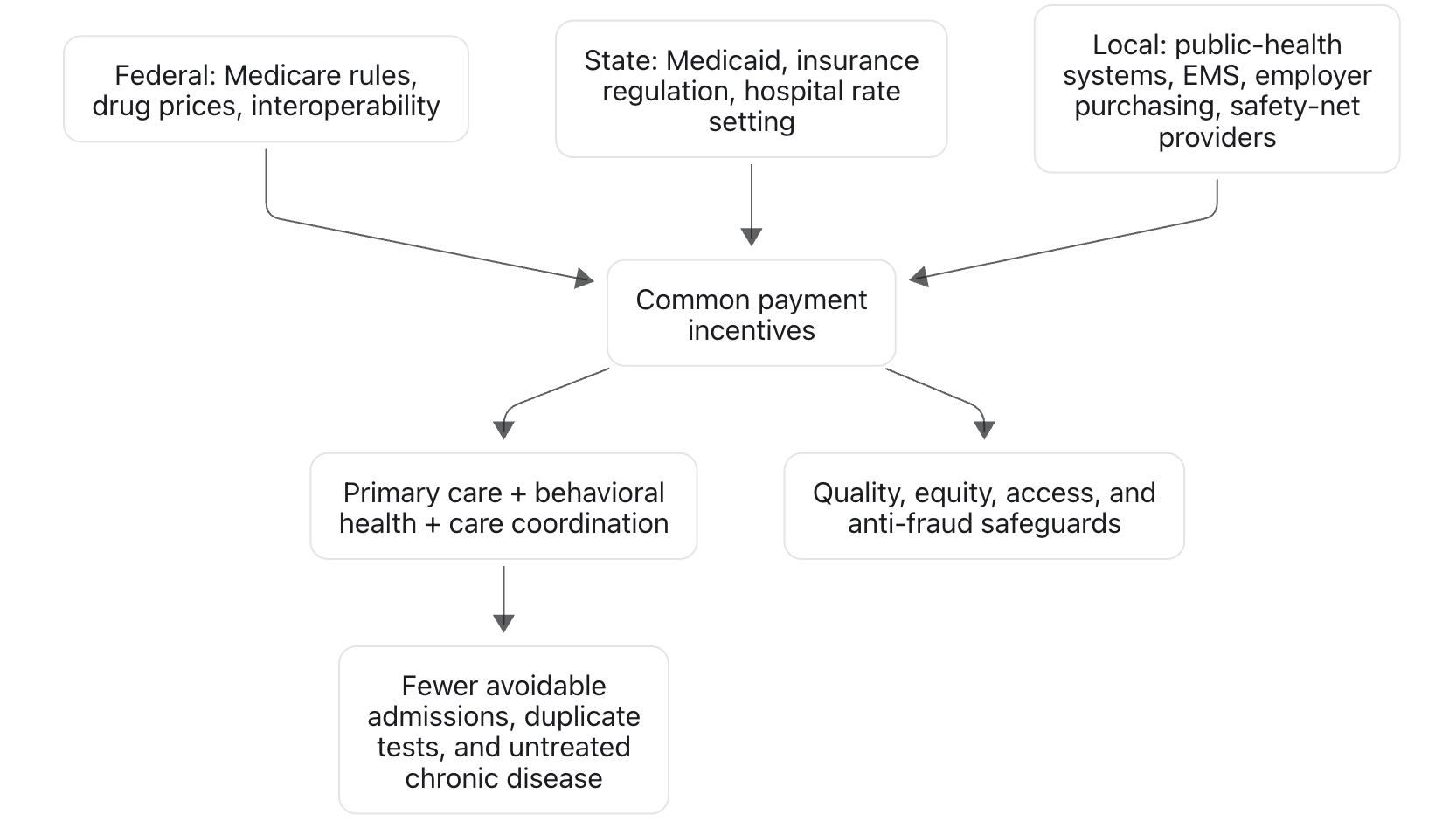
And the incentives work in both directions. Payers can accelerate the needed future state by rewarding what they want more of: faster reimbursement for value-based contracts, shared savings passed to the teams that generate them, and capital access tied to readiness rather than volume. Providers, in turn, should stop treating payment reform as something that happens to them. The organizations that build the measurement systems, the process discipline, and the governance first will be the ones positioned to win under whatever model comes next — because in a value-based world, waste elimination stops being a cost program and becomes the revenue strategy.
The readiness question underneath all of it
Every improvement on that list has been proven somewhere in American healthcare. Few of them are consistently adopted at scale. That is not a knowledge gap. It is a readiness gap.
Before an organization launches its next waste-reduction initiative, leadership should be able to answer these plainly:
- Do we know, with data, where our waste actually sits — or are we guessing from national averages?
- Does anyone own the end-to-end process, or only the departments inside it?
- Do our measures reward the outcome or the activity?
- Do frontline staff have the time, the training, and the permission to improve the work?
- Do our improvements have a control plan, or do they decay in six months?
- Are we automating a good process — or scaling a broken one?
That last question matters more every quarter. Technology applied to an unstable process does not remove waste; it produces waste faster and at greater scale. Before you ask whether your organization is ready for AI, ask whether your organization is ready to change.
Where to start on Monday
Pick one process. Measure it honestly for thirty days. Map it with the people who do the work. Remove the three largest sources of delay and defect. Put a control chart on it. Then do it again.
A 25 percent waste rate is not a permanent feature of healthcare. It is the accumulated result of processes nobody has been given the time, method, or mandate to fix. The methods exist and have for decades. What is usually missing is organizational readiness — the governance, clarity, and discipline to make improvement stick.
If your leadership team wants to move from identifying waste to eliminating it, start a conversation.
Sources
- Shrank WH, Rogstad TL, Parekh N. Waste in the US Health Care System: Estimated Costs and Potential for Savings. JAMA, 2019 — the six-category, 25 percent estimate. jamanetwork.com
- Centers for Disease Control and Prevention — chronic disease and health spending. cdc.gov
- Centers for Medicare & Medicaid Services — preventive services, chronic care management, and advanced primary care management payment. cms.gov
- Agency for Healthcare Research and Quality — potentially preventable readmissions and care transitions. ahrq.gov
An essay by TREVOR DALE.More writing →