Everywhere I turn, the conversation is urgent. Artificial intelligence. War. Iran. Economic hardship. Politics. Division. The feeling that the world is moving too fast and every headline demands we choose a side immediately.
Those conversations matter. But I want to talk about something underneath all of them: faith, religion, certainty, and what happens when belief becomes power.
I am not asking anyone to surrender faith. I am asking all of us to hold it with enough humility that it can live beside the faith, doubt, and freedom of other people.
Faith and the institutions we build around it
I have spent time trying to understand the difference between faith and religion. I do not pretend to have settled the question of God. I am agnostic and close to atheist in the conventional theological sense. But I know that human beings reach for meaning. We trust, hope, love, endure, grieve, forgive, and sometimes encounter courage or compassion that seems larger than explanation.
That capacity is not confined to one church, one scripture, one nation, or one name for God.
Faith is personal. It can be faith in God, in Allah, in a sacred tradition, in humanity, in love, in reason, or in the possibility that life contains more than we can measure.
Religion organizes belief into traditions, teachings, rituals, institutions, authorities, and communities. The distinction matters, though the two are not always neatly separable. Human beings did not invent the need for meaning. But human beings did build religious institutions. We interpreted them, preserved them, divided them, reformed them, and governed them.
That does not prove or disprove God. It does remind us that every institution carries human judgment within it. And human judgment can be generous, wise, mistaken, self-serving, or cruel.
Religious communities have given people a shared moral language. They have helped us mark birth, death, suffering, gratitude, and responsibility. They have built schools, hospitals, charities, shelters, and places where people learned they were not alone.
Those gifts are real. So is the harm.
Faith and religion have inspired service, sacrifice, forgiveness, art, and courage. They have also been used to justify exclusion, persecution, conquest, discrimination, and violence. No honest accounting turns history into a simple balance sheet.
What we owe one another when we disagree
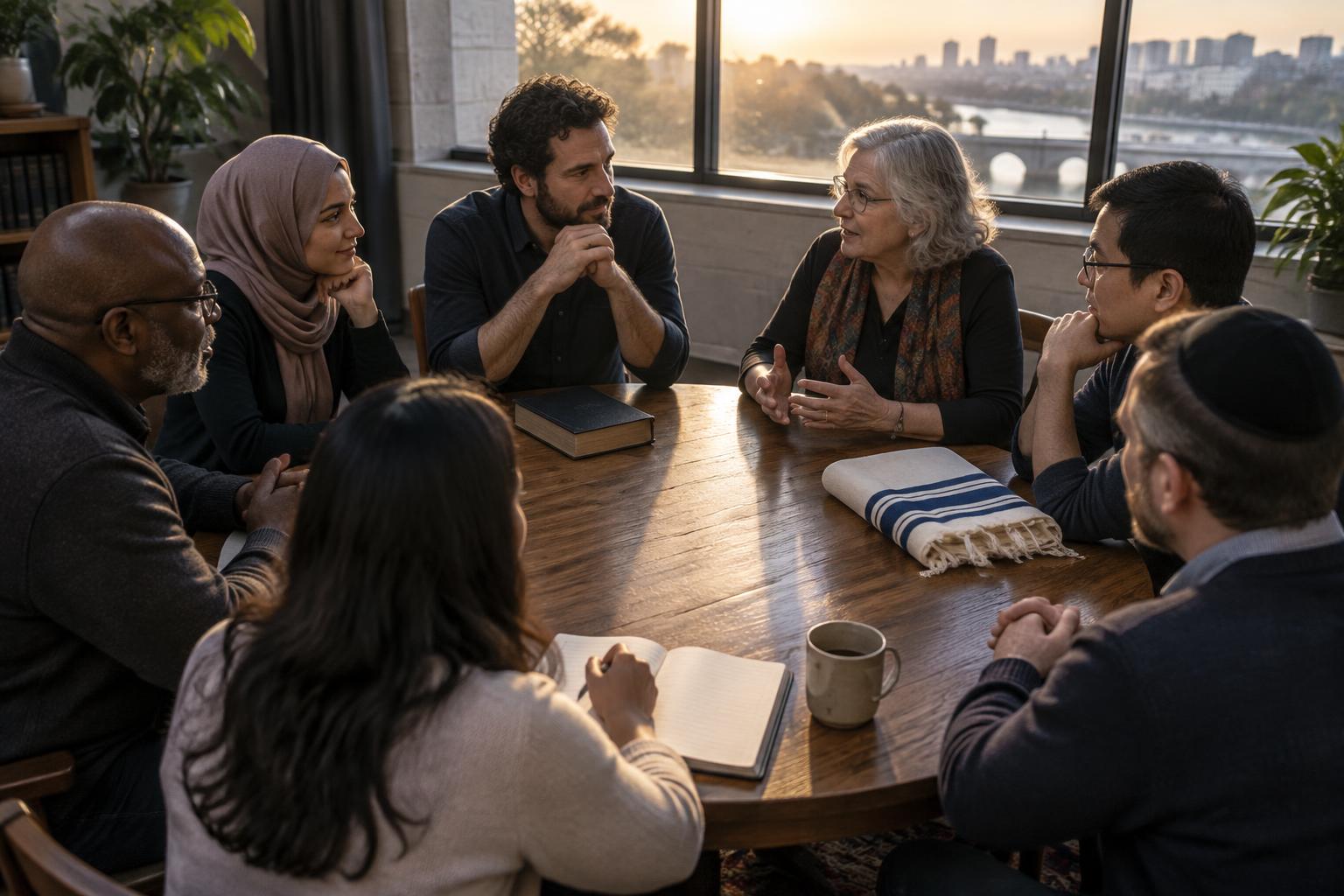
People of different religions, people with no religion, and people whose beliefs cross several traditions live beside one another, work together, raise children together, and share political power. We meet people whose deepest convictions contradict our own. We cannot honestly pretend they are all insincere, unintelligent, or unworthy of freedom.
That is why pluralism matters.
Pluralism does not require us to say every theological claim is the same. They are not. It does not require anyone to abandon the tradition that gives their life meaning.
It requires something more demanding: that we refuse to turn our own certainty into authority over another person’s conscience.
The problem is not faith by itself. The problem begins when personal belief becomes institutional certainty, institutional certainty becomes political power, and political power gains the right to compel people who do not share the belief underneath it.
A person may be completely sincere and still be wrong. Conviction is not proof.
When a political objective is presented as the unquestionable will of God, compromise becomes harder and dissent can begin to look like sin. The same danger exists in secular ideologies when they claim an unquestionable truth and demand obedience in its name.
I do not fear a person who prays, worships, doubts, or searches. I fear the moment any of us decides that our answer to life’s greatest questions gives us ownership of everyone else’s life.
A freedom worth defending for everyone
Here is what I believe we owe one another:
- The freedom to believe, worship, question, change faith, leave faith, or hold no faith at all.
- A government accountable to every citizen, not the enforcement arm of one theology or ideology.
- Room for both conviction and doubt. Believers should not have to apologize for devotion, and nonbelievers should not have to apologize for skepticism.
- The ability to challenge ideas without ridiculing the people who hold them.
- The humility to say, “This is what I believe,” without adding, “Therefore you must live by it.”
- The courage to reject sacred excuses for cruelty, no matter who offers them.
Keep your faith if it gives you strength. Believe in God. Believe in Allah. Follow Jesus. Practice Judaism, Hinduism, Buddhism, Sikhism, another tradition, or no tradition at all. Believe in humanity, love, reason, nature, transcendence, or simply admit that you do not know.
I will defend your freedom to answer life’s deepest questions differently from me. I ask for the same freedom in return.
Our common ground is not that we all believe the same thing. Our common ground is that none of us should have to surrender conscience to belong.
Keep the faith. Lose the certainty that your faith must belong to everyone.
An essay by TREVOR DALE.More writing →
Watch the companion video
Keep the Faith — Trevor Dale